CBP recently issued a Withhold Release Order (WRO) against Taepyung Salt Farm based on indications of use of forced labor. With this new addition, CBP is currently overseeing and enforcing 52 WROs as part of its mandate to combat forced labor in supply chains of goods entering the American economy. While the number of WROs continues to rise, the value of shipments interdicted for forced labor violations has actually decreased substantially since the outset of Fiscal Year 2025 (FY 2025).
UFLPA
One of the key pieces of legislation aimed at combatting force labor is the Uyghur Forced Labor Prevent Act (UFLPA), which establishes a rebuttable presumption standard that the importation of any goods, wares, articles, and merchandise mined, produced, or manufactured wholly or in part in the Xinjiang Uyghur Autonomous Region of the People’s Republic of China, or produced by certain entities, is prohibited by Section 307 of the Tariff Act of 1930 and that such goods, wares, articles, and merchandise are not entitled to entry to the United States.
So far in FY 2025, which began October 1, 2024, CBP has detained a total of 5,831 shipments under the UFLPA. Of these, 4,219 shipments were denied entry to the US while 323 were released. According to CBP statistics, in previous years the major countries of origin for UFLPA enforcement were Mexico, Malaysia, and Thailand by a good margin. While Chinese-origin shipments have so far this year represented the bulk of excluded goods, tariffs and de minimis changes may increase the share of shipments detained from other countries as CBP looks to identify transshipment violations and other actors seeking to avoid the effects of these policies.
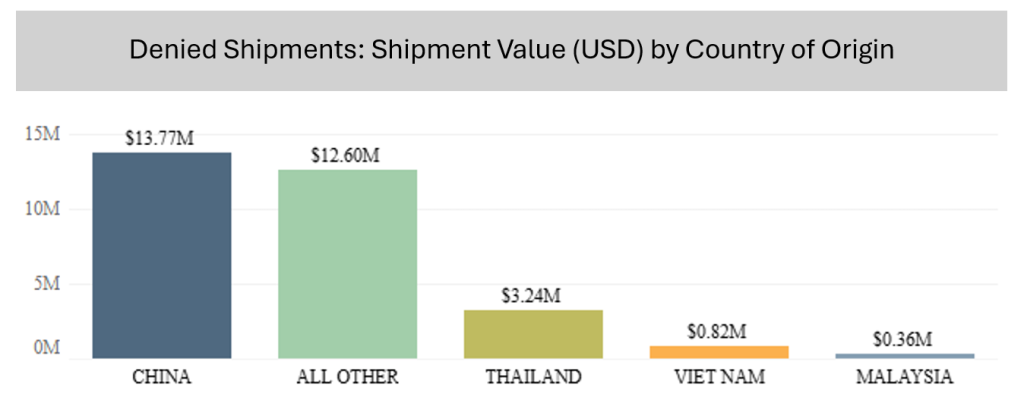
Interestingly, while CBP actions are detaining a similar number of shipments when compared to previous periods, the total reported value of these shipments has plummeted from over $1.2 billion in value at this point in FY24 to just $75 million in FY25. An additional notable trend is in the type of goods detained – in FY24 electronics were the most frequently detained commodity, while so far in FY25 the large majority of detentions are automotive or aerospace commodities.
CTPAT & Forced Labor Enforcement
CBP recently introduced a new benefit for CTPAT Trade Compliance partners that enables the utilization of Foreign Trade Zone (FTZ) for the storage of goods subject to forced labor enforcement actions. While most Importers must store goods detained for forced labor investigation in bonded warehouses, CTPAT Trade Compliance partners now have additional options and opportunities for potential cost savings while awaiting a determination from CBP.
But don’t forget, using this benefit and storing detained goods in an FTZ may not always be the most cost-effective option. For example, the recent Executive Orders imposing increased tariffs on most countries mandate that goods must be entered into FTZs under Privileged Status – meaning that by utilizing the FTZ benefit, the Importer could be locking in a current higher duty rate, if tariffs are later reduced or suspended.
So, if you’re a CTPAT Trade Compliance partner and have shipments detained for forced labor, it’s important to consult your US Customs Broker to understand the cost vs. savings before leveraging the new FTZ benefit.
For more information on conditions for leveraging this benefit, see CBP’s CTPAT Bulletin notice.