On April 3, 2026, the Department of Homeland Security (DHS) released its FY2027 Congressional Budget Justification as a supporting document to the FY2027 President’s Budget Request. The Justification provides details of DHS and component agency budgetary plans for the coming fiscal year. This budget request begins the annual appropriations process and is subject to changes as it makes its way through various processes in Congress.
Below are highlights from the request for DHS in general, and for U.S. Customs and Border Protection (CBP) in detail. As negotiations over the FY2026 are still in process, the budget request assumes, for comparison purposes, that FY2026 will result in a continuing resolution (CR), keeping funding levels identical to the previous year. Should Congress agree on a funding solution to resolve the current impasse that implements a new FY2026 budget, these values will change.
The request outlines a total of $118.39 billion in funding for DHS for FY2027, an increase of $6.35 billion from the FY2026 CR levels. A significant amount of additional funding for DHS agencies has been appropriated through the recent reconciliation package (One Big Beautiful Bill Act/OB3A), enacted in 2025, which provided more than $190 billion in multi-year funding for specific DHS programs, which are in addition to the amounts reported here.

Non-CBP DHS Highlights
ICE: The Budget maintains critical funding for ICE, equal to the FY2026 level, including $2.2 billion to maintain 41,500 immigration detention beds at base levels. The reconciliation package (OB3A) added $75 billion for ICE to implement the Administration’s mass deportation initiative, including $45 billion for ICE to activate up to 100,000 single adult detention beds and up to 30,000 family unit beds.
USSS: The Budget includes an additional $36 million for USSS protective operations. The OB3A provided the USSS with $1.2 billion to invest in protective technology and enhance protective operations. The 2027 Budget builds on these investments and includes additional funding to: manage an increase in protective travel requirements; hire an additional 852 positions, including 520 special agent positions; and begin preparing for both the 2028 presidential campaign and the 2028 Olympics.
TSA: The Budget begins the privatization of TSA’s airport screeners by requiring small airports to enroll in the Screening Partnership Program, under which TSA pays for private screeners at designated airports.
DHS Headquarters: The Budget proposes the reorganization of DHS Headquarters to consolidate the Office of the Secretary and Executive Management, the Management Directorate, the Office of Intelligence and Analysis, and the Office of Situational Awareness into a single office reporting to the Secretary.
CWMD: The Budget makes CWMD a distinct office within CISA, including all research and development, Federal assistance, the National Bio Surveillance Integration Center, and policy oversight functions. A substantial portion of CWMD’s radiation detection mission, funding, and personnel are moved under CBP.
CBP’s FY2027 Budget Request
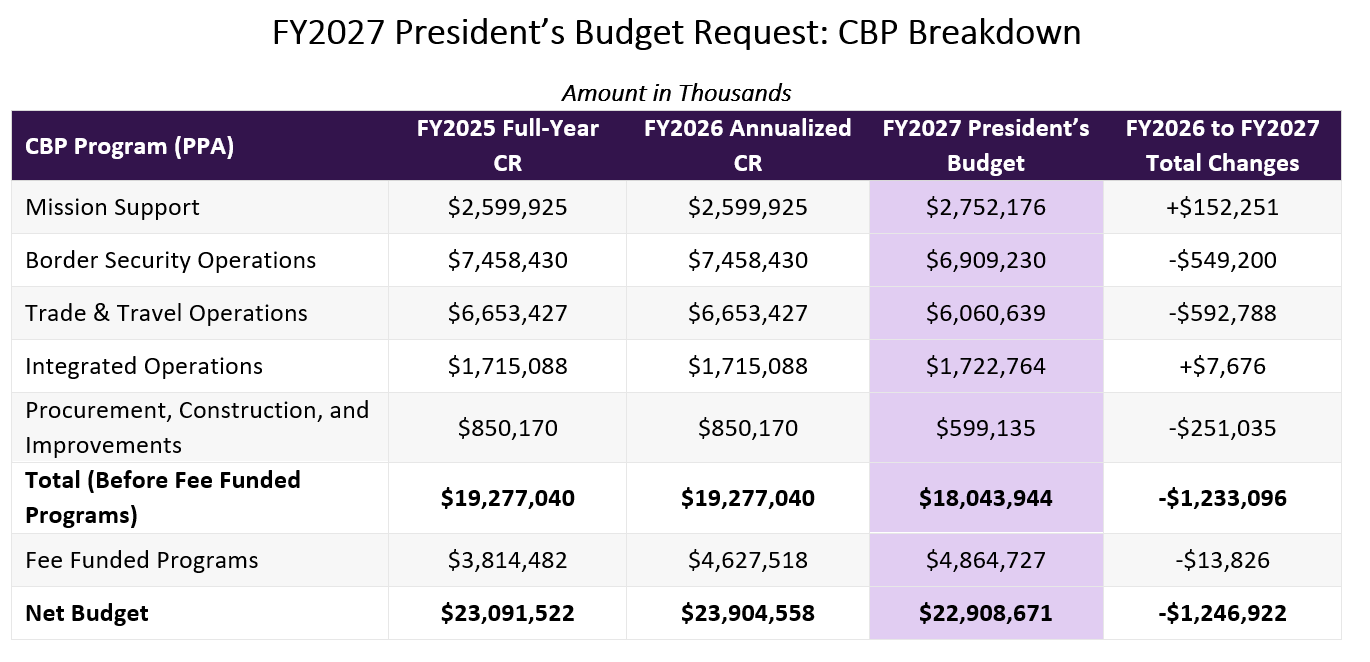
For FY2027, the President’s Budget outlines a budget authority of $22.91 billion for U.S. Customs and Border Protection (CBP), which is $1.25 billion less than FY2026 CR levels. Appropriations for Procurement, Construction, and Improvements (PC&I) are proposed to decrease by over $250M in FY2027. This net decrease is driven in large part by the funding surplus CBP received in the reconciliation package (OB3A).
Notable CBP Items
Operations & Support (O&S)
- ATAP & Forced Labor Investment – The request increases funding for the Advanced Trade Analytics Platform (ATAP) by $9M to support specialized data science activities, software development, and purchase of software licenses. ATAP focuses on the analysis of trade activity to identify transshipment, forced labor, and other violations of U.S. law. The Forced Labor program is also slated to practically double its budget from $18M to $34M in FY2027.
- New Anti-Drug Campaign: Increased funding is proposed for the National Targeting Center (NTC) and CBP field offices as part of a new anti-drug campaign. The NTC request includes an additional $108M for open source, cryptocurrency, and tactical bulk analytics to improve targeting of trafficking activities, while the field request focuses over $23M on equipment, including mobile license plate readers and specialized equipment for high-risk operations.
- Focus on AI: The request proposes several AI-specific investments, including staffing up the office of the CBP Chief AI Officer, adding over $1.7M in funding to develop AI initiatives that accelerate cargo container screening and development of algorithms to optimize screening processes in passenger and cargo environments.
- Soft Sided Facilities: Though CBP and other DHS agencies have been prolific users of these facilities in past years, the budget request eliminates all funding (-$450M) for these facilities in FY2027.
- Team Awareness Kits: The request includes a $12M increase in budget for Team Awareness Kits (TAK) for the Border Patrol. These devices are used in the field to receive data and communicate in remote locations devoid of communications infrastructure.
Procurement, Construction, & Improvements (PC&I)
- Border Security Technologies: After receiving record-setting funding levels through the OB3A in 2025, the request for FY2027 does not include any procurement funding for integrated surveillance towers, ground sensors, or other detection systems.
- Non-Intrusive Inspection: After receiving record-setting funding levels through the OB3A in 2025, the request for FY2027 does not include any procurement funding for the NII program.
- Counter-UAS: The request includes $80M for counter-UAS technology at 25 priority ports of entry along the southwest border. The funding covers infrastructure upgrades at these locations as well as procurement of equipment and integrator support.
- Radiation Portal Monitors: Following the reassignment of the RPM program from CWMD to CBP, the request includes $21M for the deployment of a limited number of RPMs at CBP sites, as well as funding for the deployment of previously procured iRAIL RPMs at rail border crossings.
- Extended Border Foreign Operations Surveillance: The request $155M for one C-130J EBFOS aircraft with integrated mission systems to conduct foreign operations with joint interagency partners, gather intelligence, track surface and airborne targets, transport personnel and equipment, and respond to natural disasters with mobile command and communications. CBP received funding for an initial C-130J as part of the OB3A in 2025, making this the second purchased airframe.
- Automated Commercial Environment (ACE): The President’s FY2027 Budget Request provides $136 million for the Automated Commercial Environment (ACE) technology investment, which manages payments for tariffs and trade, facilitating ACE implementation a year ahead of schedule.