For many global companies, participation in the CTPAT Program doesn’t stop at just one account. Different business units, divisions, or subsidiaries may each hold their own CTPAT certification. While this structure can provide flexibility, it often leads to duplication of effort, inconsistent procedures, and added risk when accounts aren’t aligned.
Successfully managing multiple CTPAT accounts requires more than meeting deadlines. It demands a coordinated strategy that promotes consistency, efficiency, and accountability across the entire enterprise. Without strong oversight, companies risk fragmented reporting, uneven security standards, and conflicting approaches to due diligence.
By following proven best practices, companies can maximize the benefits of their CTPAT certification while minimizing inefficiencies and risk.
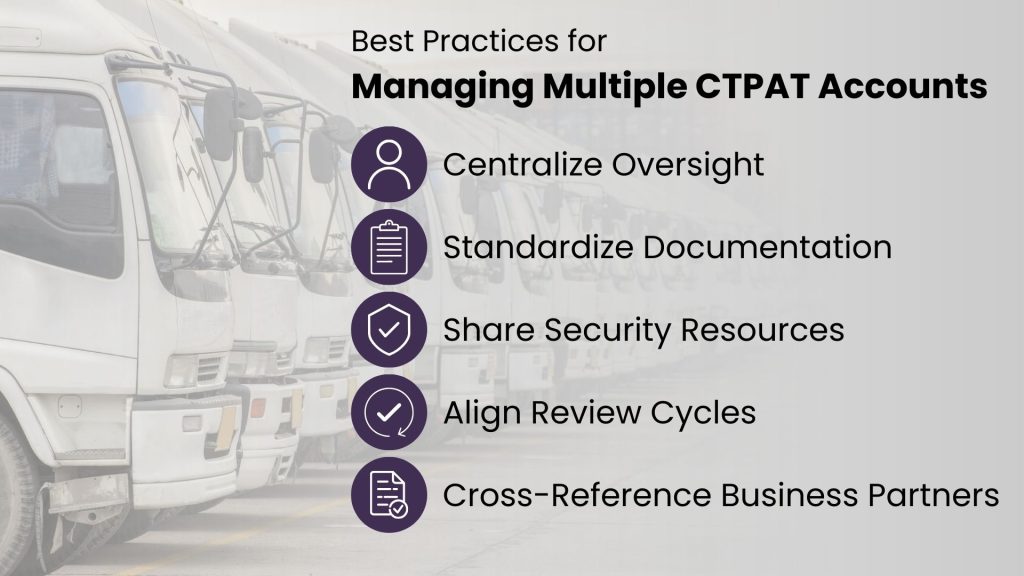
Best Practices for Managing Multiple CTPAT Accounts
1. Centralize Oversight
Appoint a dedicated corporate security coordinator or compliance team to oversee all accounts. This ensures consistent policies, risk assessments, and reporting.
2. Standardize Documentation
Use uniform templates for security profiles, risk assessments, and business partner screenings to streamline compliance across accounts.
3. Share Security Resources
Leverage common training programs, security measures, and threat intelligence to strengthen all business units.
4. Align Review Cycles
Coordinate updates, validations, and annual reviews across accounts on the same schedule to reduce administrative workload.
5. Cross-Reference Business Partners
Maintain a centralized database of vetted partners so that every account benefits from prior due diligence efforts.
When to Merge Multiple CTPAT Accounts
Merging accounts within the CTPAT Program can simplify compliance, but it’s not always the right choice. Consider consolidation if:
- Unified Corporate Entity: All business units operate under the same legal entity. Be aware that ONLY the same business entity types can be merged.
- Identical Security Procedures: Multiple accounts have nearly identical security profiles and procedures.
- Overlapping Partner Networks: Vendors, carriers, and customers are largely the same across accounts.
- Centralized Management: A single corporate office manages compliance activities and decision-making.
⚠️ Important Consideration: Be aware that merging accounts can be a risk, as a suspension from the CTPAT program would now apply to the entire entity network.
Strengthening Your CTPAT Program
Effectively managing multiple CTPAT certifications requires strategic oversight, standardized processes, and careful alignment of security practices. Whether your company is considering consolidation or simply needs to improve coordination across separate accounts, a well-structured approach will help reduce risk, streamline compliance, and strengthen supply chain security.
Our team has extensive experience guiding organizations through the complexities of the CTPAT Program. We’re here to help your business stay compliant, efficient, and fully aligned with U.S. Customs and Border Protection (CBP) requirements. Check out more about our CTPAT Navigator services.